 What are the chances that two gay couples go in to two conservative Christian Bakeries on two continents and order two cakes to be inscribed with a message supporting gay marriage? Well you probably know the answer to this but in case you don’t I will continue the tale. Predictably, the two bakeries reject the order explaining that it is against their religious principles to support gay marriage and equally predictably each gay couple take a case against the Bakeries with their respective Equality Agencies claiming discrimination. The cases go through a number of iterations with the governments funding the claimants and the Bakeries having to appeal for funding from the general public to support their defence. What do you think so far, Gay conspiracy or pure coincidence?
Well, as usual, I will go for the middle ground and suggest that this was just a copy cat case, stopping short of suggesting a co ordinated attack on religious beliefs over two continents. How did the respective Supreme Courts decide the case? In both Courts they found for the bakers but there were significant differences in the ratio decidendi of their judgements. In the US the Supreme Court skirted the issue of Freedom of Speech and decided by a count of 7 – 2 that the Equity Agency that first tried the case and defended the plaintiffs, were themselves prejudiced. The judgement was drawn quite narrowly and focussed on the facts of this case and was reported as follows: “Justice Anthony M. Kennedy’s majority opinion turned on the argument that the Colorado Civil Rights Commission, which originally ruled against the baker, had been shown to be hostile to religion because of the remarks of one of its members. “(New York Times,04/06/18)
In contrast the UK Supreme Court found by a unanimous verdict of 5 – 0 that, “Freedom of expression, as guaranteed by article 10 of the European convention on human rights, includes the right “not to express an opinion which one does not hold”, Hale added. “This court has held that nobody should be forced to have or express a political opinion in which he does not believe.”(The Guardian, 10/10/18) The judgement splits the facts of the case into two halves. The Bakery did not refuse to serve the couple because they were Gay. There was no issue in respect to selling any of the goods on display and the Court clearly recognises this.
Ashers did not discriminate against Gareth Lee …. because he was gay. They agreed to make him a cake but refused to decorate it with the pro gay marriage wording he requested. Peter Tatchell
The plaintiffs were not refused service because they were gay and therefore the actions of the bakers was passive. However, trying to make the bakers express a political opinion against their will was an active infringement of the bakers rights. This would appear to be self evident and although the Court went to great lengths to support current equality legislation, it clearly refused to grant superior rights over those who did not agree to promote their ideology. Peter Tatchell makes the point that we need to look at the implications of a ruling against the Bakers, ” If the Supreme Court had ruled against them, it would mean that a Muslim printer would be obliged to publish cartoons of Mohammed and a Jewish printer could be required to publish a book that propagates Holocaust denial.” (Peter Tatchell)
This would appear to be such a common sense ruling that a person on the Clapham Omnibus would have seen the logic very quickly yet the Equality Commission for Northern Ireland spent £250,000 of public money supporting the plaintiffs. A Spokesman for the Commission said, “We are very disappointed. This judgment leaves a lack of clarity in equality law.” (The Guardian) I would argue that the Supreme Court has established an important principal of personal freedom and that the only thing that needs to be clarified is the role of the Commission. Was it establish to promote fairness and equality for all or just the interests of it’s clients?
references: The Times, 11/10/18, Peter Tatchell, Judges Ruling on Gay Marriage Cake is Victory for Freedom.
New York Times, 04/06/18, Adam Liptak, In Narrow Decision, Supreme Court sides with Baker….
The Guardian, 10/10/18, Owen Bowcott, UK Supreme Court backs Bakers ….
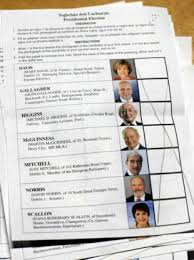 I didn’t vote for a second term for Michael D, not because I feel that he is not qualified for the job but that he is too qualified when measured by the old time political metrics. Don’t misunderstand me, at the first election he was the only one who understood the constitutional role and limitations of the Presidency. I had hoped that his promise for a one term Presidency meant that perhaps this was the final fling of the political consensus that sent an old politician to the Aras for a nice retirement, leaving the major centrist parties free to ignore an inconvenient and expensive election. But leopards don’t change their spots, especially old ones. Once Michael D had his feet under the Presidential Desk at the Aras for seven years the prospect of unemployment seemed less inviting. Had either of the two Mary’s made this about face there would have been outrage but because it was Michael D, no one was really surprised. No one was surprised about delaying his decision to run so that opponents had to scramble to seek adoption by councils that were on holiday. No surprise either that they would have no time to build a campaign or, that he was suddenly so busy that he could only debate on his terms. This was old style and typical of the smoke filled rooms that gerrymandered politics of the past.
 I would think that it is fairly rare that one day after the implementation date of a new Act that headlines such as ‘Drink Driving Laws too Weak’ would appear(The Times 27/10/18) . However, this is the Act that Minister Ross introduced to appease public pressure to do something about the mess that are the RTA’s and their policing. It was also a Bill that was heavily criticised, not for the proposed penalties but for any realistic attempt to reform the rickety structure that governs enforcement of the Road Traffic Acts in Ireland. I wrote an essay on the subject in July, using data mainly drawn from an RTE program and the basic issues that were raised were not addressed in any serious way