It is with some reluctance that I approach my latest essay, not with my usual heightening blood pressure or, a sense of righteous indignation but with a sense of sadness and despondency. I am writing about their Royal Highness’s the Duke and Duchess of Sussex. I hardly know where to start but I suppose the event that forced them to my attention was the Oprah interview. For a couple that wanted to step away from all the media attention and make their own way in the world, they seemed to have taken a wrong turn in appearing on prime time television. It is quite obvious that a quiet retirement was never an option and I am pretty sure that we will find it difficult to avoid them as they tell their ‘lived experience’ of Royal oppression to a gullible Oprah audience. I had formed my opinion of the Sussex’s character some time ago and felt that with the move to Canada the divorce between them and the Monarchy suited both parties and the country.
However, I knew that given their lack of character that it wouldn’t stop there. I think that there is more than a casual similarity with the Edward and Mrs. Simpson story especially with the personalities of the people involved. I think that Harry is like Edward in that he is fragile, lazy, wants to be the centre of attention but doesn’t want to do the work. He is attracted to a dominant figure that promises to release him from the boredom and suffocation of his duties. Meghan is a ‘B’ list actress who wants to be a media ‘A’ list star and made the same mistake as Wallace-Simpson by thinking that being a Royal will give her that exposure. A bit harsh do you think? You only have to look at the carefully choreographed interview, with the Diana look and the focus on the victimhood of The LittleMermaid. The LittleMermaid!
There were so many questions that Oprah didn’t ask, that to an unbiased observer, the whole story crumbled for lack of any context or, substantiation. The claim that Meghan did no research into the Royals is beyond belief. But once they had connected, did Harry not bring her up to speed? Did he not brief her on his own misgivings about the job or the supposed Royal racism? Did he not discuss his version of his mothers story? Where was he when his wife was feeling suicidal? Who was it who made that comment about Archie? This predictable playing of the ‘race card’ was typical of the whole miasma of tales that only served to support the fantasy of the poor American innocent who was ruined by those evil Royals. By the way, it is interesting to note that Harry, having witnessed the production of the race card, then refuses to support it “That conversation I am never going to share,” Really, …. watch this space. Where there were facts they were either wrong or conflated in support of the narrative. For example, the implication that Archie was barred from being a Prince because he was non white. This was intended for an American audience who wouldn’t know that the issue of granting this title was decided by George V in 1917. Again, this story was delivered by a couple who wanted to step back from the ‘Firm’ but wanted to keep all the advantages, including financial support from Charles.
There is a fundamental misunderstanding about the role of the Monarchy in the British Constitution. As a result of the interview I heard a lot of commentary on both sides of the Atlantic about how the Royals have no power, how they exist only to shake hands and open factories but that is to miss the central role they have in modern political life. Yes, they take part in colourful and quaint ceremonies like Trooping the Colour. But note that it is the Queen’s Colour that is being trooped by the Queen’s Guards. It is not Boris or a Government Minister who takes the salute but a member of the Royal family. When you receive your tax demand through the post, the envelope is marked with the legend, ‘On Her Majesty’s Service‘ (or in the case of James Bond, ‘On Her Majesty’s Secret Service’). Judges sit on the Queens Bench, that tax demand is delivered by The Royal Mail, the policeman’s helmet is surmounted by the Royal cypher and so on. Is this just a hangover from the past with no relevance to today? Well, yes and no. It is a fluid connection to the past and a confirmation as to what it means to be British. It represents tradition and good practise but it also performs a subtle but essential delineation of political power. At the opening of Parliament each year, the Queen delivers the Queen’s Speech outlining her government’s program for the coming Parliament. This takes place in the House of Lords and the Queen sends her official, Black Rod, to summon the M.P.’s in the House of Commons to attend. The door of the Commons is slammed shut as Black Rod approaches and he/she has to knock three times before he/she is allowed in. A quaint piece of colourful drama, even down to a little heckling of Black Rod as he/she delivers the Royal summons? Yes but also a marker to show the supremacy of Parliament over the Crown and of the Commons over the Lords. This, fully costumed vignette, encapsulates British Constitutional development of the past 150 years. The Monarchy occupies the spaces where a potential challenger to Parliamentary Supremacy would develop.
My discussion of the place of the Monarchy in modern Britain is less than comprehensive. The role is complex and encompasses economic, cultural, constitutional and political aspects of Britain’s past and present. It is firmly interwoven into the constantly changing fabric of society and has had to accommodate many Harry and Meghan moments and has survived. My concern is the erosion of the sense that with rights come duties. With our obsession with living vicariously via social media and the values of vaguely defined social justice. The Queen and her father, George VI, set a moral standard for a Head of State that is unequalled anywhere else. Their example encapsulates the virtues of honesty, hard work, fairness, duty, common sense, loyalty, respect and personal responsibility. This is in contrast to the shallow lives of the Edward and Wallis Simpsons and the Harry and Meghans of this world who want celebrity status without sacrifice and claim victimhood when their demands are not met.
I was saddened to see the riot and attack on Capitol Hill last Wednesday (6/01/21) and especially the loss of life that occurred. A note of caution before we go any further. We should learn our lesson from the past few months and not jump to the conclusion that these four people were ‘killed’ as a result of the riot, as was reported by CNBC (07/01/21) . We see from the same report that three deaths are provisionally listed as ‘medical emergencies’ and at the time of writing there is an investigation into the deaths of Ashli Babbitt and subsequently, Officer Sicknick.
Having said that, the President has lost the opportunity to leave his mark as the person who changed the political dynamic in the States by standing up for common sense and country. The Glitterati, led by George Clooney, say that his name will forever be linked to “insurrection” and the Democratic press will make sure of that. I think that history will take another view. When all the articles from the legacy Press have faded and the Chat Shows have been forgotten the President’s Legacy will be that he challenged progressivism , forged by the elites of the press, the Arts, the Universities, Big Tech and the Democrats.
Though the Left would love nothing more, Trump supporters are not going away. The same bill of complaints leading to Trump’s ascension remains. Trump didn’t arise in a vacuum, and the Left’s mission to fundamentally transform America that gave birth to Trump and Trumpism is not only alive and well but is even more dangerous now that Democrats have captured control of the two political branches of our government.. David Limbaugh
I have to pause to highlight the sheer opportunism of Chuck Schumer comparing the riot with the attack on Pearl Harbour which was noted in a report from News 24/7, ‘The Senate minority leader’s flair for melodrama is so well known that in a city full of publicity-hungry politicians, it’s an old joke that “the most dangerous place in Washington is between Chuck Schumer and a TV camera.”‘ If we accept that this wasn’t a second Pearl Harbour or 9/11, it is serious enough to give the President’s enemies enough ammunition to compromise all the work he has done in the last four years and make the choices for the GOP more difficult going forward.
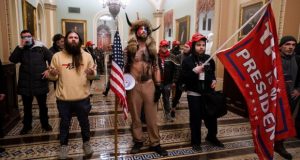
f Supporters of US president Donald Trump stand by the door to the Senate chambers after they breached the US Capitol security in Washington, DC, USA. Photograph: Jim Lo Scalzo/EPA
What I find interesting amongst all the talk of this being the greatest threat to the constitution is the conflation of the , rather exotically dressed leaders of the riot/ mainly peaceful protest, with all those who disagree with the liberal establishment. David McWilliams wrote a piece in the Irish Times subtitled, ‘The white working class is slipping down the US and global pecking order.’ (9/01/21) The article can nearly be summarised in following quote, “In absolute terms the “deplorables” are not much worse off than they were 30 years ago, but relative to the brown and black people who used to do their laundry, they are sinking.” He manages to introduce the Hillarian elitist term, “deplorables” early in the diatribe but doesn’t really define who he means. They are white, of course and male perhaps the above picture could serve as an identity kit to mark out his targets. Most of the support for his contention that these ‘deplorables’ are entitled and resistant to change seem to be rooted in the 19th century. One of the few modern examples he uses refers to the high success rate of West African immigrants in employment. He produces no evidence that the white working class, have demonstrated against any immigrant who would contribute to the common good. Was he saying that this demonstrates the high level of education in Africa that will fuel the increased competitiveness of the continent with the U.S.? If so, that will affect everyone and I would suggest that given the education levels in different ethnic groups that the white working class will not be the most impacted. I would add that it wasn’t the ‘deplorables’ who discriminated against Asian immigrants who wanted to access higher education but the Harvard elites.
What do we make of this sort of stereotyping ? The first thing to note is that the left have learnt little over the last number of years. If we take Brexit as an example the Remainers created a straw man of the typical Brexiteer. He was white, male, probably an ex football hooligan with a Union Jack T Shirt and aggressive tattoos. His only political belief was that immigration was bad and that you couldn’t trust foreigners. The Remainers continually called the Brexiteers ‘racist’ and reiterated the Clinton line, “it’s the economy stupid”. What they hadn’t noticed was that the debate had shifted and the question was now the same one that Maggie Thatcher posed, who is running the country? Cummings had found disenfranchised voters who knew that their voice wasn’t heard by those in power. The issue was now cultural, political as well as economic. As with the Clinton (Hilary this time) election the left in the UK was shocked to see the collapse of the ‘Red Wall’ and suffered a resounding defeat. David McWilliams may be correct in his economic forecasts, although perhaps he could tone down his glee over the demise of the U.S. but empires rise and fall and he is right that change is the natural order of things. What I don’t see is half of the voting public in the picture he has drawn. Statistically some of that number has to be non white. He refers to the, “…. brown and black people who used to do their laundry.” Does he know any working class people? Is he suggesting that the working class own or, ever owned slaves? He mentions that soon women will have more wealth than men, does the working class not have a few women amongst them?
What he and his elitist colleagues have done is to draw a very narrow picture of anyone who opposes their narrative. He has created a straw man, a member of the ‘American Honky-Tonk Bar Association.’ complete with cowboy boots and AK47. After applying the racial, gender and classist filters to conservatives there are no women, no people of colour, no one with any education, no one outside this imaginary group. He accuses the working class of feeling entitled but I would suggest that they are not looking for a hand out, as are the various lobby groups of the progressive left but rather a hand up. They are not afraid of work, something he might discover if he ever actually talked to anyone outside of his bubble. At the beginning of the First World War the British Army was called “Contemptable” by the Kaiser and they happily adopted this name and became the ‘Old Contemptables’ that eventually defeated him. By the same token I am happy to become one of the ‘deplorables’ and look forward to the return of common sense and respect to all my fellow country men/women. There are two effects of applying the Goebbels principle; one has been amply demonstrated over the past four years where you repeat something untrue like, ‘Trumps is a Russian Agent’ and through sheer repetition the base start to believe it. The second effect is that you start to believe it yourself.
Sources
David Limbaugh, 8/01/21,www.dailywire.com/news/limbaugh-trumps-agenda-must-survive-his-presidency.
Four Dead After Pro-Trump Rioters Storm Capital Jennifer Elias, Kevin Breuninger, Marty Steinbergw.cnbc.om/2021/01/07/four-dead-after-pro-trump-rioters-storm-capitol.htm
Capital rioters can’t stop the economic forces undermining their tribe., David McWilliams, 9/01/21,www.irishtimes.com/news/world/us/us-election/david-mcwilliams-capitol-rioters-can-t-stop-the-economic-forces-undermining-their-tribe-1.4452498
“Happy what would be Notting Hill Carnival my beloved London” Adele
You couldn’t describe me as a great fan of Adele but I surely qualify as a casual fan with four of her songs on my Spotify favourites list. I had heard about her weight loss and attendant criticism and thought, go for it girl, never mind the be-grudgers. I see that she has attracted even more be-grudgery by posting a picture of herself wearing carnival costume featuring the Jamaican flag. I have to say that she looks fantastic although not sure about the hair do. The problem was that she was dressed, carnival style whilst lamenting the cancellation of the Notting Hill Carnival this year and this woke up the woke police who accused her of cultural appropriation.
Now there are a couple of issues I have with Adele, the first is her politics which is left of mine but she will see the error of her ways as she gets older and wiser. The second is not so easy to fix as she comes from Tottenham and as we all know Tottenham Hotspur is the poorer side of the London derby with Arsenal. I am not calling for her cancellation for supporting the wrong team as the statistics are enough to make the point i.e. Arsenal won 77 league matches against 59 by Tottenham to date. Apart from that, I don’t see any cause for the sensitive and idle to go into frenzy mode and talk of cultural appropriate as though Adele was proposing a pogrom against the Caribbean community in London. The local MP, David Lammy, put it in context,” This humbug totally misses the spirit of Notting Hill Carnival and the tradition of ‘dress up’ or ‘masquerade’ .Adele was born and raised in Tottenham, she gets it more than most. Thank you Adele. Forget the Haters.”
On a historical note, the Carnival grew out of the Notting Hill riots in the 1950’s and was an attempt to ease racial tensions. So, much like the St Patricks Day Parades around the world it is intended to celebrate ethnic pride but also to welcome and share with other cultures a wonderful and joyous occasion.
Carnival is rooted in Caribbean culture, with its Windrush-generation influence remaining strongly evident, it is at the same time characteristically ‘London’ – today’s modern London. CVT
If you have read the home page of this Blog you might be under the impression that the writer would never attend such a noisy and crowded event. But I was there and have the T Shirt to prove it. You can imagine this rather subdued person entering the world of sheer exuberance, ground shaking music and firework coloured characters as they danced and sang in pure joy. The Notting Hill Carnival is part of all London and all of London is part of it, no one has cultural ownership here.
Just as a matter of interest, a round of applause to anyone who can calculate the highest number of PC sins committed in the essay so far. I have come up with four but think that we could increase this score with a bit of effort. Go for it Girl in the first paragraph must score at least two strikes. In the meantime, in the real world, thank you Adele for bringing some joy, fun and colour in an increasingly puritanical grey world. I am sure that your beloved London returns your salutations and wishes you, in turn, a Happy Notting Hill Carnival Day.
References
Carnival Village Trust, https://nhcarnival.org/nhcs-story
I was struggling with a blog concerning the General Flynn case in the US, the main problem being, how do you encapsulate this complex story and convey the absolute scandal that it is. It is basically a story that contrast the naive but honourable soldier with the actions of a political class who corrupted the organs of the State to ‘nail’ their man. This feeds into the whole Russiagate story which was unbelievable from it’s beginning and became more sinister as it played out, driven by a compliant press and desperate opposition. The trouble is that if you control the establishment media then any criticism is treated as a conspiracy but any conspiracy imagined by the media is impartial reporting. So for three years we were told that Meuller will expose the conspiracy and Adam Schiff claimed that he had confidential information that will sink Trump. Well we all know where that went! However, there are still those that believe the lie, how can that be? The answer is that if you control the mainstream media you can follow the advice of someone else who also wanted to promote an ideology that changed the culture of his day, Joseph Goebbels.
“If you repeat a lie often enough, people will believe it, and you will even come to believe it yourself.” ~ Joseph Goebbels
Still trying to find a way of telling the Flynn story I read two articles in the Times which might bring together the title of this essay, Goebbels, General Flynn and the full stop.
The first piece was by Deborah Ross, entitled ‘I’m writing this with no full stops so as not to seem aggressive.’ It does what it says on the tin, a humorous piece written with only one full stop at the end. Apparently, she was responding to a new wave of protest that determined that the full stop was, “‘aggressive‘ …’not sincere and marked you out as ‘old‘”. Quite a lot of sub text for such a small piece of punctuation. The criticism appears to be from the young to the old and I can see that it reflects the change in technology, over time. We don’t write letters anymore but text abbreviated messages in a constant stream of the mundane. In business, we rarely write full reports but substitute with visual aids and bullet points. I personally think that we have lost something on the way but can accept that if you are sending a one line text, then if you don’t want to finish with a full stop, then don’t. Having said that I must pause for a second and listen. Do I hear the world collapsing, rioting in the streets (If you are reading this in the US, you can skip this one) sounds of old ladies and gentlemen expiring? Nothing, …. nobody cares. I think that this lack of response prompted the addition of aggression and lack of sincerity to the offense. I haven’t seen the logic behind this but I think that there are those who are determined to be offended and an attack on the poor full stop means that they are really scraping the barrel.
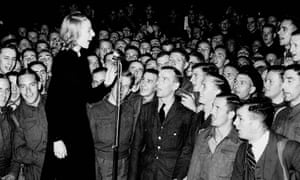
Do you sense a theme yet? Perhaps if I say that the second article is by Matthew Moore and entitled Rule, Britannia! row: Proms decision a ghastly error, says former BBC chairman (sic) you will start to see the connection. Poor old Aunty BBC is all about providing what the BBC thinks is good for the populous and rushing to ensure that no minority can be offended by anything it produces. In doing this it tramples on the culture, history and identity of the majority without a second thought and is constantly surprised by the reaction it provokes. The latest tangle was the suggestion that they were going to drop Rule Britannia and Land of Hope and Glory from the final night of the Proms this year. Their reason for doing this was the difficulty of staging them and meeting the challenges of COVID 19 in performance and if it was anyone other than Aunty I would cut them some slack. However, I think that in the recent past the top floor has been uneasy about all the flag waving and expressions of joyful nationalism that didn’t fit into their view of Britain as a European country. What is more likely to have happened is as reported in the Sunday Times. “They have been meeting regularly over Zoom but have yet to agree the Last Night programme, which is on September 12. They are also concerned about how to strike a sombre tone during a global pandemic and how to respond to the ongoing debates over race equality.” (The Sunday Times, 23/08/20) This is more the BBC I know that spends it’s time deciding how I should deal with the virus and what my position should be on the racial controversy which they are promoting. I take a different view on the words and sentiment of the songs. I think that those who sang Rule Britania in 1807 and 1833 would have a different take on them than post Brexit BBC Management. I think that my parents generation singing the words of Land of Hope and Glory, as they stood alone in 1940 would have had another interpretation and the fact that the Vera Lynn versions sits at the top of the itunes charts, speak to this. I think that the modern promenaders would take their own message of joy and inspiration from the songs focussing on the present and the future.
I think that the 2019 General Election was less about the economic arguments about membership of the EU and more about a clash of cultures. It revealed a political class that knew what was best for everyone else and a large section of the community that was just tired of the constant attacks on normal life. Both sides crossed traditional political and class divides but the extent to which the old voting blocks were upended came as a big surprise to the progressive elites. People were frustrated by the Parliamentary games that were being played to defeat the Brexit vote and in the US to corrupt the FBI and Justice system. They are tired of hearing endless lectures about how a man can become a woman and how they want to be addressed. As referred to above, even punctuation becomes fraught with meaning and consequences if you make the wrong choice. As for the BBC, we need only to look at the following extract of the Mission part of the BBC Charter to question how far they have drifted from the original promise.
The Mission of the BBC is to act in the public interest, serving all audiences through the provision of impartial, high-quality and distinctive output and services which inform, educate and entertain. extract from the BBC Charter
In the case of the two songs, we understand the technical problems and perhaps Gareth Malone could have done something imaginative to raise spirits during the Covid crisis. Instead of lifting spirits Aunty chose to look for the dark side to reflect the virus and the progressive obsession with race. It seems that the strategy of these elites are to wear the rest of us down, They took a bloody nose in the last election but using the loose confederation of sympathetic causes they are prepared to push progressivism at every level, every minute. So from corrupting the organs of state, to politicising the language and trying to rewrite history you can see how they work against us. On that note i think that I just about linked General Flynn, Goebbels, punctuation and patriotic songs in a theme that reflected the title of this piece, Land of Hope and Glory … are we sure?
If nothing else, the current Corona virus pandemic has focussed us on the need for data to assess risk and to inform policy. However, it is one thing to produce data and another to weigh it’s validity and to interpret what the underlying message is. It is with this in mind that we must be very careful how we judge how well our decision makers have performed in the current crisis. The real test is that of a historian who will ask whether any other course of action was viable given the background ‘noise’ and ‘chatter’ and contradictory expert advice.
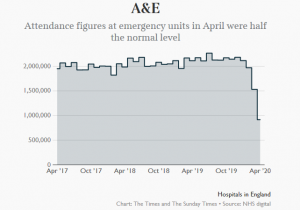
Having said that there was one set of data that caught my eye as it touched on not one but two of my previous essays (see below). In an article in The Times, Kat Lay had reported that the doctors in the NHS were concerned that patients were holding off attending A&E because they were afraid of catching the Corona virus. For English hospitals, the number of attendees had fallen by 57%, comparing April 2020 with April 2019. In whole numbers, that means a reduction of 1.2 million visits, month on month. “Dr Nick Scriven, immediate past president of the Society for Acute Medicine, said the drop in A&E attendances was “a significant concern” and people’s conditions may have worsened as a result.
“This is a ticking timebomb in itself and it will be exacerbated by a myriad of other pressures in the coming weeks,” he said.”(The Times 14/05/20)
Of course there are some obvious reasons for the decline in numbers mentioned in the article and referenced on the graph opposite. Working from home means that there is far less traffic on the roads and partly for this reason there were 27,000 fewer ambulance calls y-on-y. What is missing from the article and the medical references, is voiced in the comments attached to the article and was the subject of my earlier essays (see below). It is the elephant in the room. Let’s take a couple of comments that give a flavour of the frustration of readers with the journalist, for not asking the obvious questions.
Willie Deadwilder: Surely this is to be expected. Fewer drunks on the streets means fewer admissions to A&E plus fewer people at work means fewer workplace accidents. It’s not rocket science.
Lenny:Of course you are right. Why can’t our dozy journalists do some basic research or ask the right questions to A&E staff? It does not fit with the prevailing narrative of doom and gloom.
Paramaniac: I work in the Ambulance Service and all I can say is thank you lord, thank you so much for giving us a small break in the mind numbing incessant c**p we normally go to.
I realise it won’t be for long and once C19 is over we’ll be back to doing the incessant mind numbing c**p we do in the Ambulance Service but thanks for while it lasted.
What wasn’t discussed in the article was the effect of those who either attend A&E because it is free or, they can’t be bothered to go to their GP and those who attend because of anti social behaviour. Of course, there are a number of people who don’t attend, who should attend. There are those who feel that they shouldn’t bother the Health Service at this time and stoically suffer on when they should seek help. There are those who are afraid of catching the virus, whose condition will deteriorate and they will be one of the ambulance calls that will become an emergency. What we don’t see in this article is the reason for the paramedics prayer of thanks in the Comments.
How does this article and it’s omissions connect with my two essays on the subject. The first one, entitled Minister for Health (03/09/18 see below) described my reaction to the unveiling of a new health plan entitled Sláintecare. I suggested that a plan cannot be a plan without costings otherwise it is merely the Ministers aspiration. I went further to suggest that there appeared to be a dearth of management information that would serve as a platform for making plans. For example, at the time there was a lot of heat being generated about people on trolleys in A&E. However, there seemed to be very little light in the way of in depth verifiable data on the subject. We just about knew the number of people involved but even this was a source of dispute between the HSE and A&E Unions but beyond that, very little. My second article Addendum to the ‘Minister of Health Article (01/03/20 see below) followed up on the first one by commenting on the statistic that in 2018 the HSE conducted a survey of 293,976 hospital discharges and found that 33,929 (11.5%) patients were discharged the same day and 55,510 (18.8%) were discharged within 24 hours. There seemed to be a curious lack of interest as to why this was the case. The lack of Junior Consultants at night was one guess that was hazarded but there appeared to be no real effort or, ambition, to discover how many of those discharged within 24 hours should have been there in the first place.
We can sense a theme running through these observations with similar characteristics. First of all and most obviously there seems to be a dearth of detailed information in relation to Health issues. The issue of under resourcing A&E has been a long running story for a number of years but we only see a large scale survey being made in 2018. I have yet to see a comprehensive breakdown on these numbers that would be the basis for solving the problem. Secondly, part of the reason for lack of any cohesive logical response is the quality of reporting. In the case of the current Times report perhaps Kay Lay should take Lenny’s advice in the Comments section and do a follow up article based on an interview with Paramaniac or, one of his/her colleagues. Thirdly, as mentioned in my first essay, there is no responsibility for value for taxpayers money in the Health service. The Children’s Hospital is a prime example of this. For one of the most expensive capital projects in the health service there was an incompetent political and managerial oversight of the project. There has to be far more transparency and ownership of all parts of the health service. In my essay I suggested that there should be an independent internal audit section that would publish its findings on a regular basis and make clear who is responsible in cases of failure. Fourthly, an outsiders view of the Health Service is that it is being run mainly for the benefit of employees and not the patients. I hasten to add that frontline staff are heroically trying to perform miracles in an environment that seems to be in constant crises. However, when the budget is increased there never seems to be any question of making efficiencies, for example reducing administrative staff in favour of front line and medical support staff. Instead, what we see is a form of internecine warfare to make sure that everyone in the industry gets their share. Perhaps that is too harsh a criticism at a time where frontline staff are risking their lives but I think on reflection there is a feeling that they are, ‘Lions led by donkeys’. Lastly, the poor old politicians must share in the ‘Donkey’ category. They have distanced themselves from the management of the service and are reluctant to get bogged down in any attempt to make it more efficient and up to date. The inmates run the asylum and react very strongly to any attempt to change the status quo.
Having said that, there is much to treasure and we see, on a daily basis, the commitment and self sacrifice that health workers are prepared to undergo in their service to others. It is the system and management, both political and operational, that need to change to match this level of service.
References
The Times, 14/05/20, Kat Lay, Coronavirus: A&E visits plunge to lowest on record,
Now and again you come across an report or, some data related to an article you wrote at an earlier date. Such an article appeared in the Irish Times, under the heading, “30% of admitted patients discharged within 24 hours is ‘absolutely crazy'”. It seems that in 2018 the HSE conducted a survey of 293,976 hospital discharges and found that 33,929 (11.5%) patients were discharged the same day and 55,510 (18.8%) were discharged within 24 hours. In times where health service resources are stretched the first question that comes to mind is how many of these patients should have presented at the hospital at all. The article did go on to give some context to these number and in the absence of any published detail we have to be careful about drawing conclusions. For example, a percentage of patients would have been discharged from one hospital to be transferred to another for specialised treatment. Also, the consultants are quick to point out that often junior staff are left to cover the out of hours shifts and do not have the training, experience or, confidence to discharge patients and so they are given beds until a more senior colleague can make the decision.
I wouldn’t think for a moment that Simon Harris follows my Blog but it is coincidental that the survey was conducted in the same year that I wrote an article about the importance of getting the raw data together and analysing the numbers before tipping even more taxpayers money into the Health industry money pit. (See the link to the 2018 article below) In the absence of any other published material I can find, I find it astonishing that the survey was conducted as late as 2018 and that the conclusions are only reported in 2020. I assume that further investigations are being made into the type of health issue presented and whether HSE resources were being used in the best way.
I hope that what we are seeing is like the proverbial duck above water whilst all the activity is below the waterline, soon to be released to an unsuspecting public. I say ‘unsuspecting public’ as nothing approaching a set of clear management accounts has emerged from Simon Harris or, the HSE and I think that the tax payer would be astonished if something like a sign of good management and governance should appear in the near future. In the recent election I saw many promises of extra expenditure on public services but very little mention of getting value for money. Just throwing money at a problem solves nothing. There is no alternative to understanding the fundamentals and drivers of the Health Service but what has filtered through to the public is very disappointing.
Language is a very powerful thing, we understand the functionality of it but really don’t think much about it until we encounter a problem. A rather tired analogy is to compare it to the air we breath, it is necessary for life and is all around us but we take it for granted until it disappears. Todays essay is not about anything so important and central to life but rather a look at the periphery, the small changes that continuously happen around the edges that betray great adventures with language.
I regularly receive a Newsletter which I scan and then consign to the bin. I have written before about that awareness you get when you finish reading but your instincts tell you that you have missed something important. I got the same feeling after reading the current edition. I retrieved it from the recycling bin and re read it. I just couldn’t get rid of that feeling that on the periphery of my vision I had missed something. Then it hit me! Instead of referring to ‘men and women’ in the editorial the writer referred to ‘women and men’. If you don’t instantly understand my interest then I am not sure that I can explain it to you. Perhaps, if I start by saying that in most written description of the two sexes, prior to twenty years ago, the format would have been men and women. Just in that simple sentence there is a whole world of debate but in the latest edition of my newsletter the sexes had been reversed. I checked on line to see whether this was a one off occurrence but it seems that over the last three editions the the format had been consistent ‘women and men’. Therefore the change was as a result of editorial policy.
Why does this matter? You could say that it doesn’t matter at all but then why go to the trouble of consistently making this change? The more likely explanation is that it is in response to the idea that all things stem from a Paternalistic culture and that the reversal of male and female, in this context, is in response to this. If that is the case then I see some logic but little merit in the policy. However, it has succeeded in tweaking my interest but I don’t think that is the intention. Throughout history language has not just been about facilitating normal life but also in encapsulating a culture. At the time of the Roman empire you had the concept of the Pax Romana which exemplified the benefits of being a Roman and was evidenced by the universality of Latin as the language of the ruling classes. To some degree this applied to the Norman invasion of Britain and Ireland with the imposition of Norman French; the imposition of English as the language of the British Empire and of American English reflecting the current empire of the U.S. This can also apply to ideologies, for example, the pronoun ‘they’ and ‘them’ has been pushed as the preferred gender neutral address to trans people. The changes do not have to become all embracing but introduced a little at a time, to be effective. Currently, there is a challenge to the Connecticut Interscholastic Athletic Conference (CIAC) over the inclusion of two male swimmers, who declared as female and won first and second place in women’s races. The case has been filed in the Federal Court under a Title IX discrimination claim that women athletes have been deprived of of 15 state championship titles and more than 85 opportunities to participate in higher-level competitions since the CIAT allowed the two men to compete.
The Connecticut case highlights the argument that small changes can hide significant cultural shifts. Ten years ago, who would have needed a court to decide who was a woman and who was a man (right way around?). I would be interested to see how the Editor of my newsletter would view the case as I assume that ‘they’ are arguing that woman and men are very different whereas, the CIAC is saying that it is merely a matter of self identification. The reason that we should challenge these changes is that they are insidious and constant usage breeds a familiarity that blunts the normal common sense filter that is even more vital in these times. I hope that I have persuaded you to be ever more vigilant and seek out and challenge things that just do not make sense and perhaps we might have a more open and honest discussion about change as a result.
I was attracted to an article in the Sunday Times Food section today, which is unusual as I normally skip this section in search of something more bloggable. What interested me was that it described what appeared to be a pragmatic approach to the problems of the small farm sector in Irish farming. The recent headlines showing farmers blockading meat processing plants are an indication that not all is well in the industry. I have to admit that I approach environmental issues with a ‘shields up’ approach as it is almost impossible to separate ideology from science and as I have said in other articles, we are in a world where there is no room for doubt, no room for questions, you are either for or, against. So, it was refreshing to see that people had by passed the drama, threats and politicking and had put their ideas into practise.
The new small farmers want to set the farming clock back to pre 1970’s methods. Their marketing strategy is right for the initial stages in that they get very close to their customers. In one of the examples in the article, the producer discussed planting with his chef customer who, was given sufficient time to alter his menus to get the produce as it was harvested. This works well with a non price sensitive niche market but the concept is right for expansion either by direct selling to the end customer through farmers markets or, via the internet. However, it wouldn’t be a blog by disgruntled from Dublin if that was all. I was searching for a certain sentence and it came midway through the piece when it mentioned a scheduled “gathering” (not protest?) outside Leinster House, “…to call on the government to protect our soil and value it as much as they do.” (Sunday Times, 22/09/19) The problem with most environmental groups is that they sell their soul to ideology and instead of taking practical steps to lead by example they just join the background noise demanding that everyone else has to change to their way of thinking. The danger to Talamh Beo is that by engaging in the political debate and seeking government protection or, funding, they become just another interest group in a sea of similar groups.
What differentiates Talamh Beo is that it is small scale and very close to it’s customers. It is as much a social force as a commercial or environmental one and it must keep it’s principles and relationship to it’s customers before all else. It must not be seduced in to joining a larger ideological movement where it will try to save the world by political means rather than practical leadership I think that there is a market for food grown by people that you know and that is a market that is prepared to pay above supermarket rates. The small farmers need to hammer away at this target and not be distracted by seeking government support that always comes at a price. Developing a personal relationship with your customer is literally growing organically with the advantages of a bond of trust between customer and supplier that will withstand the vagaries of the market. Good luck to Talamh Beo I hope to be reading about a quiet revolution taking place in the countryside led by a hands on group that benefits all.
The Sunday Times, Food, Corinna Hardgrave, 22/09/19, Irish growers go back to their roots.
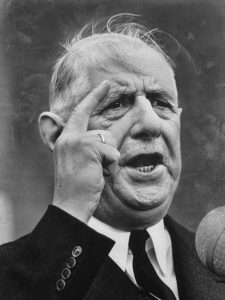
I have avoided writing a commentary on Brexit, partly because of it’s complexity and partly because the debate centres around fault lines rather than the underlying fundamental issues. I was sent the following article, written by George Friedman and it became clear that Charles De Gaul understood and predicted the current crisis. What it says is that you must understand what has happened in the past before you can explain the present. There are a number of things that De Gaulle got wrong but overall he put historical context first and this is what I think the debate should be about.
Brexit and Charles de Gaulle’s Last Laugh
In many ways, de Gaulle foresaw the crisis Britain is now struggling to pull itself out of.
As we watch the British government tear itself apart over its relationship to Europe, it is useful to stop and consider the deeper origins of the crisis. They go back decades, to the long-standing tension between Britain and Europe, and in particular between Britain and France. Britain was not a signatory of the 1957 Treaty of Rome or any of the prior agreements that led to European economic integration. But in the 1960s, it applied to join the European Economic Community. At the time, Britain was economically weak, having never fully recovered after World War II, and saw the EEC as a free trade zone with relatively few complexities. The country had stayed clear of excessive entanglement with continental Europe but felt that having less limited access to Continental markets would help in its recovery. But the British application to join the EEC was blocked by France in 1963 and 1967. French President Charles de Gaulle argued that the British economy was in many ways incompatible with the rest of Europe’s. He also argued that Britain had a deep-seated animosity toward any pan-European undertaking and would perceive a united Europe as a threat to its independence. De Gaulle didn’t view Britain as a fully European country, since its history ran counter to Europe’s history. Since the Norman conquests, Britain had been fencing with Continental powers, playing one off against the other to prevent any one power from becoming strong enough to storm the English Channel and conquer it. Whereas the other European powers were primarily land powers, forced by geography to focus on the threats posed by their neighbors, Britain was a naval power, whose primary response to Napoleon, for example, was to protect itself through a blockade that weakened France. From de Gaulle’s point of view, Britain fought World War II the same way – by shielding itself and abandoning France. The British understanding of economic life, according to de Gaulle, was also incompatible with Europe’s. The British economy was driven by private investment, innovation and risk-taking. Continental economies had a much more intimate relationship with the state, which helped shape the direction of the economy and cushioned the impact of capitalism on workers. The state’s relationship to the market, therefore, was also very different. De Gaulle did not see the state as intruding on the nation but as the embodiment of the nation. The European Union derives from the same tradition de Gaulle did. Neither objected to private property, but they believed in the need for state intervention in all aspects of life. The EU has a regulatory bent that is far more intense than the British, and sees its bureaucracy as having authority far greater than Britain’s. De Gaulle had other bones to pick with the British. Britain’s relationship with the United States troubled him deeply. De Gaulle saw the U.S. as the logical and extreme expression of British ideology and strategy. The U.S. marginalized the state and, like Britain, was prepared to fight to the last European to block the Soviets. De Gaulle recalled the U.S.-British alliance in World War II, and the degree to which he had to resist having France reduced to a dominion of the United States and Britain during and after the war. The tension between Britain and the Continent didn’t end with World War II, and Britain’s relationship to the United States compounded it. De Gaulle saw the alliance between the Anglo-Saxons as representing a multi-faceted threat to the Continent. In particular, he did not want Europe in a fixed alliance that committed the Continent to military action under certain circumstances. He didn’t want another war in Europe and was not prepared to take the same risks the U.S. was claiming it was prepared to take. He saw NATO as a threat to the EEC in many ways. He also saw the Soviets as a manageable threat, and the Americans as reckless. From de Gaulle’s perspective, then, if Britain were to join the EEC, it would act as a tool of the United States, and he was not willing to let that happen. For de Gaulle, the cultural gap between Britain and a united Europe couldn’t be bridged. They were just too economically incompatible and their strategic interests too different. De Gaulle’s goal in all of this, however, was not simply to build a European community. He wanted to build a European community that France could dominate, something that was still conceivable in the 1960s, while Britain remained outside the bloc. And in trying to achieve his goal, he actually anticipated the problem that would arise with the Maastricht Treaty, which established the European Union. Britain has a very different economic and political culture than the Continent. It has a different history that gives it a different view of the Continent. Leaving other matters aside, it does not fit into Europe, and the attempt at bridging this gap has led to the worst political crisis in Britain since the fall of France.
There are, of course, many other variable to consider when looking at the current situation. Globalisation, technology, urbanisation, environmental issues have all changed the world since De Gaulle’s day but he identified key difference between Britain and the continent that still hold true. Most of them have a historical trajectory and you can see an example of this by contrasting the constitutions of Britain and Europe. Most of the EU countries have written constitutions that has been forged after conflict, whereas Britain has a mainly unwritten constitution that has evolved over time and is grounded in common law. This has evolved into the principle of parliamentary supremacy whereas, by revolution or war the continental systems have produced a stronger executive branch that can take unilateral decisions with much less constraint. We can see this in the way that Brussels, Germany and France rammed Monetary Union (EMU) through on the back of the Maastricht Treaty to consolidate national currencies into one European currency. I can remember people saying that Britain’s refusal to join reflected her attachment to the pound and empire but what made more sense was that Britain and a few other states just couldn’t see how it would work. In the end they were proved right and the fundamentals of a stable currency have still not been resolved. What was seen to be an attachment to former glory was, in fact, a practical assessment of the EU’s plans which were the product of an ideological construct and the ambitions of a politicised bureaucracy.
Britain joined the EEC which was a common market that retained decision making at the national level. I think that most British people accepted that, over time, as economies moved together so would the links between countries. The problem was that France and Germany wanted to keep up the momentum to expand the geographical community and the power of the EU establishment. The problem of keeping up the pace is that you can quickly create a disconnect between the people that you are representing and the governing body. It became very clear that the Maastricht Treaty was treated with suspicion by many countries and to counter the fears of forced centralisation the concept of subsidiarity was established. The principle of Subsidiarity does not just state that decision making be devolved to the lowest competent authority but that it is the responsibility of the central authority to make the case that it is necessary to take it away from local jurisdiction.
Specifically, subsidiarity means that proponents of centralisation are the ones who have to prove that further integration is justified. If they fail to make the case, subsidiarity means that the powers should remain de-centralised. (Making Sense of Subsidiarity: How Much Centralization for Europe?)
The authors of the 1993 report, Making Sense of Subsidiarity: How Much Centralization for Europe? clearly saw the tension between “efficiency-enhancing centralisation and democracy-enhancing sovereignty.” It also identified the principle’s weakness in that it was not defined in law and that any dispute was adjudicated by the ECJ, hardly a disinterested body. The inevitable consequence has been the expansion of Brussels at the expense of local decision making. To paraphrase Ronald Reagan, Brussels will never voluntarily reduce in size and the EU bureaucracy is the nearest thing to eternal life that this earth will ever see.
If the trade-off that Europe has chosen cannot be explained and justified to citizens, consequences are unavoidable. The loss of sovereignty can easily turn into a loss of identification with the European project, and, as seen today, the missing identification can generate a dangerous democratic deficit, and a concomitant longing for the autonomy of the nation-state.
The problem, that was clearly seen by the authors of the 1993 report , has come about. The institutions of a European wide super state are all there. The flag, anthem, judiciary, executive, parliament, external borders, membership of the UN and the beginnings of an EU military are all there to see. But who will defend this super state? Yes, we can identify the economic benefits and for some the prevailing liberal ideology but the democratic deficit that the report identified has resulted in a return to identification with the nation state that can be seen all around Europe.
Liberal governments in Continental Europe saw the Nation State as the source of all modern wars and in the aftermath of the Second World War it seemed reasonable to look for a convergence of states that would lock them together so that there would be an end to international conflict, at least in Western Europe. This would seem a reasonable strategy especially between Germany and France who between them had produced a Napoleon, Kaiser and Hitler to terrorise the continent in modern times. However, the claim that the EU and it’s predecessors have kept the peace in Europe is only partially correct. As already stated, it has stopped two member states from repeating past adventures but has it secured peace from external threats? De Gaulle’s belief that the Russians can be negotiated away have thankfully never been tested. The reason that the post war expansionist communist states were held at the western borders is NATO. De Gaulle’s nightmare had come about. It is the presence of those Anglo=Saxons that has prevented a nuclear tipped Russian advance into Paris not the EU. To be more precise, it is the presence of 60,000 U.S. troops in Europe, plus all the America military might, on call, that has held Russia in check.
De Gaulle was wrong on many fronts. Partly as a result of his humiliation during the war he incorrectly identified the main threat to post war Western Europe as being the Americans and British. However, his analysis of the differences between Britain and the continental Europeans can hardly be faulted. This means that, given the ambitions of Brussel and Paris, that the union was never going to work within the current framework. It would not fail on immigration, EMU or, the ‘great British sausage’ but on the impossibility of forcing a continental culture onto a British one. Whatever happens to Brexit the EU still has the same problems with the remaining countries and we can see the fault lines wherever you look. The problem with the model is that it attracts little loyalty from it’s citizens. Yes, we all identify as Europeans when we go through passport control but if asked where we come from we respond in national terms. We like the mobility and economic advantages when things are going well but have no accountability when things go wrong. We are told that that there is democratic control via the European Parliament but the electorate rightly sees through this myth and shows little enthusiasm for European elections. What they do see when they make a stand is that huge pressure is put on national governments to correct this aberration as happened when the Irish electorate rejected the Lisbon Treaty in the 2008 referendum. There are many things right with the EU but it is a house built on a shaky foundation and it is not clear whether this is accepted by the ruling elites or, whether they will ignore all the warnings and continue to build even higher in a desperate hope that the foundations will somehow hold.
Charles De Gaulle ( 22/11/1890 to 9/11/1970)
Reference:
GPF, George Friedman, 2/04/19, geopoliticalfutures.com/brexit-charles-de-gaulles-last-laugh/
Jean-Pierre Danthine, Subsidiarity: The forgotten concept at the core of Europe’s existential crisis, 12/04/17, https://voxeu.org/article/subsidiarity-still-key-europe-s-institutional-problems
I was saddened to hear of the death of Doris Day today. She epitomised the dreams of post war America as it settled down to prosperity and super power status. Her screen persona was that of the clean living girl next door reflecting all of those all American values that underpinned the American dream .
Born Doris Mary Ann Kappelhoff in 1922 she was destined to be a dancer until a car accident broke both her legs and confined her to a wheel chair where she sat next to the radio, singing along to the big bands of the day. She particularly studied the voice of Ella Fitzgerald and I fancied that I could hear that influence, especially in slower numbers that allowed her to extend her phrasing. She subsequently broke into the big band scene, changing her name to Day when she made her debut with Barney Rap in 1939.
Doris Day at the Aquarium, New York, July 1946
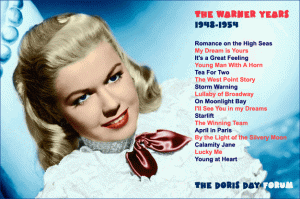
She described her time touring with the bands as her happiest and she rose to fame with six top ten hits in 1945/46. This included her signature song, Sentimental Journey which became the song associated with the returning troops. She commenced her film career in 1948 with the film Romance on the High Seas and this was the first of some forty films in a long career. We forget how big a star she really was mainly because she was type cast as the feminine star in romantic comedies which did not result in lifting an Oscar. However, in the early sixties she ranked number one at the box office four times, a record only equalled by eight people since. She acted opposite almost all of the biggest stars of the time including Clark Gable, Cary Grant, James Cagney, David Niven, Jack Lemmon, Frank Sinatra, Ronald Reagan, Richard Widmark, Kirk Douglas, Lauren Bacall and Rod Taylor. As with most Hollywood stars her private life did not reflect her screen roles and with four marriages, one of them being violent and finding that her third husband had spent her fortune she did not have an easy life.
DORIS DAY-warner-years
In 1968 she started the last phase of her career by appearing in the Doris Day Show which lasted for five years. Initially, she was obliged to perform to fulfil a contract that her husband had made without telling her. She had also promised to repay the debts that her lawyer had caused by making bad investment decisions which was the subject of a law suit that was only finalised in 1979.
Doris Day stood for a number of things to those who remember the 50’s and 60’s. She played the clean living, all American girl next door and had a strong moral code which was illustrated by her turning down the role of Mrs Robinson in the Graduate on the basis that the script was vulgar and offensive. She had a very warm and distinctive voice which was enhanced by the recording techniques of the time that had the effect of bringing the listener into an intimate space with the singer. I always thought that her singing Move Over Darling was one of the sexiest songs that I had ever heard. I still have it on my Spotify list. She was the last to represented the Golden Age and had to face the loss of innocence of the late 60’s when her film career started to fade. What saw her through all her tribulations over the thirty five year she was in the public eye was her honesty, sense of duty, sense of humour, talent and sheer professionalism.
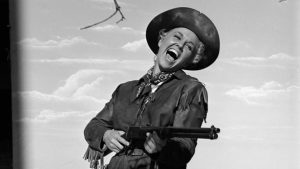
It is difficult to get a true sense of who Doris Day was. I think that she was a very private person and her later years would seem to bear this out. Looking through the photo’s on the net they all seem to be controlled and posed and the only one I saw of her where she seemed natural is the one taken of her on the set of Calamity Jane below. As we get older we filter our memory so that we tend to recall only the happier times and the sound of Doris Day singing brings me back to a steamy kitchen with Two Way Family Favourites on the radio. I have failed to do her justice in this essay and even to tell of the important moments in her life. Failed to record all of the tributes and honours she received; failed to record the reconciliation with her son who died before her in 2004. All I can say is that I miss her and thank her for all those memories.
 t is with some reluctance that I approach my latest essay, not with my usual heightening blood pressure or, a sense of righteous indignation but with a sense of sadness and despondency. I am writing about their Royal Highness’s the Duke and Duchess of Sussex. I hardly know where to start but I suppose the event that forced them to my attention was the Oprah interview. For a couple that wanted to step away from all the media attention and make their own way in the world, they seemed to have taken a wrong turn in appearing on prime time television. It is quite obvious that a quiet retirement was never an option and I am pretty sure that we will find it difficult to avoid them as they tell their ‘lived experience’ of Royal oppression to a gullible Oprah audience. I had formed my opinion of the Sussex’s character some time ago and felt that with the move to Canada the divorce between them and the Monarchy suited both parties and the country.

 Do you sense a theme yet? Perhaps if I say that the second article is by Matthew Moore and entitled Rule, Britannia! row: Proms decision a ghastly error, says former BBC chairman (sic) you will start to see the connection. Poor old Aunty BBC is all about providing what the BBC thinks is good for the populous and rushing to ensure that no minority can be offended by anything it produces. In doing this it tramples on the culture, history and identity of the majority without a second thought and is constantly surprised by the reaction it provokes. The latest tangle was the suggestion that they were going to drop Rule Britannia and Land of Hope and Glory from the final night of the Proms this year. Their reason for doing this was the difficulty of staging them and meeting the challenges of COVID 19 in performance and if it was anyone other than Aunty I would cut them some slack. However, I think that in the recent past the top floor has been uneasy about all the flag waving and expressions of joyful nationalism that didn’t fit into their view of Britain as a European country. What is more likely to have happened is as reported in the Sunday Times. “They have been meeting regularly over Zoom but have yet to agree the Last Night programme, which is on September 12. They are also concerned about how to strike a sombre tone during a global pandemic and how to respond to the ongoing debates over race equality.” (The Sunday Times, 23/08/20) This is more the BBC I know that spends it’s time deciding how I should deal with the virus and what my position should be on the racial controversy which they are promoting. I take a different view on the words and sentiment of the songs. I think that those who sang Rule Britania in 1807 and 1833 would have a different take on them than post Brexit BBC Management. I think that my parents generation singing the words of Land of Hope and Glory, as they stood alone in 1940 would have had another interpretation and the fact that the Vera Lynn versions sits at the top of the itunes charts, speak to this. I think that the modern promenaders would take their own message of joy and inspiration from the songs focussing on the present and the future.
 Of course there are some obvious reasons for the decline in numbers mentioned in the article and referenced on the graph opposite. Working from home means that there is far less traffic on the roads and partly for this reason there were 27,000 fewer ambulance calls y-on-y. What is missing from the article and the medical references, is voiced in the comments attached to the article and was the subject of my earlier essays (see below). It is the elephant in the room. Let’s take a couple of comments that give a flavour of the frustration of readers with the journalist, for not asking the obvious questions.
 Now and again you come across an report or, some data related to an article you wrote at an earlier date. Such an article appeared in the Irish Times, under the heading, “30% of admitted patients discharged within 24 hours is ‘absolutely crazy'”. It seems that in 2018 the HSE conducted a survey of 293,976 hospital discharges and found that 33,929 (11.5%) patients were discharged the same day and 55,510 (18.8%) were discharged within 24 hours. In times where health service resources are stretched the first question that comes to mind is how many of these patients should have presented at the hospital at all. The article did go on to give some context to these number and in the absence of any published detail we have to be careful about drawing conclusions. For example, a percentage of patients would have been discharged from one hospital to be transferred to another for specialised treatment. Also, the consultants are quick to point out that often junior staff are left to cover the out of hours shifts and do not have the training, experience or, confidence to discharge patients and so they are given beds until a more senior colleague can make the decision.
 I was attracted to an article in the Sunday Times Food section today, which is unusual as I normally skip this section in search of something more bloggable. What interested me was that it described what appeared to be a pragmatic approach to the problems of the small farm sector in Irish farming. The recent headlines showing farmers blockading meat processing plants are an indication that not all is well in the industry. I have to admit that I approach environmental issues with a ‘shields up’ approach as it is almost impossible to separate ideology from science and as I have said in other articles, we are in a world where there is no room for doubt, no room for questions, you are either for or, against. So, it was refreshing to see that people had by passed the drama, threats and politicking and had put their ideas into practise.
 I have avoided writing a commentary on Brexit, partly because of it’s complexity and partly because the debate centres around fault lines rather than the underlying fundamental issues. I was sent the following article, written by George Friedman and it became clear that Charles De Gaul understood and predicted the current crisis. What it says is that you must understand what has happened in the past before you can explain the present. There are a number of things that De Gaulle got wrong but overall he put historical context first and this is what I think the debate should be about.