Well, what’s the Blog about today? Judging from the title something to do with the Borrowers perhaps or, Terry Pratchett’s The Wee Free Men? Hard to believe that this is an extract from a ‘blistering attack’ on men (Irish Independent, 08/03/19) delivered by a government Minister. Given the quote, you will be surprised to hear that it was delivered by the Minister for Higher Education, Mary Mitchell O’Connor. So, not entirely that far from the land of fiction and make believe. The Minister was announcing the creation of 45 women only professorships in advance of International Woman’s Day and complaining that there was a lack of interest from men. Well not a total lack of interest but measured as, “… small, as in teeny-weeny small.”
I am not quite sure how to approach the speech as reported in the Independent. Certainly, Margaret Hickey went straight for the throat in her article in the Examiner entitled, Women-only Professorships a Triumph of Optics over Policy. Her main thrust was on the lines of ‘physician heal thyself’ referring to the low representation of women in the Fine Gael party and in the government as a whole.
Well, it just shows it comes down to optics, and lobbying too no doubt, and it is as crass a piece of social engineering as one could find. The worst aspect of it is that it does a disservice to women.(Irish Examiner,19/11/18)
Margaret was not holding back there but she has a point in that the Minister has picked an easy target in implementing discrimination or, affirmative action in the education industry whilst failing to look at her own glass house. At this point I must state that the other sneaky policy of funding parties according to their gender balance should also attract condemnation. Confidence in democracy depends on there being a secret and unconstrained vote and any social engineering by the government to ensure that only the ‘right choices’ are presented to the electorate are fundamentally distorting the democratic process and contrary to the spirit of the Constitution. (see note) To get back to the Ministers plan, what we are seeing is the doctrine of equality of outcomes. We have seen this in the explanation that Hilary Clinton gave for 52% of white women voting for Trump in the 2016 election. The thinking was that there was no point polling white women because they, as victims of the patriarchy, would obviously vote for a woman candidate. When they voted for a somewhat bizarre candidate, the only explanation Hilary could think of was that they were misogynistic. In other words, if there is an imbalance in the gender equation or, if the party line isn’t followed then it must be down to discrimination.
David Quinn in his article (Sunday Times, 25/11/18) points out that it is not that simple and the Department of Educations own gender equality task force has found that, “… in the past 10 years, 30% of applications for professorships were women and 28% of those promoted were woman. Women made up 32% of applications for associate professor and got 31% of those jobs.” If that is the case, it would suggest that women have a very high success rate when applying for promotion which we wouldn’t expect to see if there was institutional bias in the system. Part of the reason for the imbalance is the stereotyping of gender roles by girls making study choices. In the case of STEM subjects a study showed that, “of 1,500 girls between the ages of 11 and 18 and 2,500 women aged 19-23 in the UK and Ireland found 30 per cent felt Stem subjects were better fitted to boys’ brains, personalities and hobbies.” (Irish Times) The article goes on the describe various initiatives being undertaken by the business world to change this view but it also shows that the real way to sustainable changes in the gender balance is to have equal opportunity rather than outcomes.
I am glad that Margaret Hickey raised the next point . She says that, “There is plenty of research to show that women value work/life balance more than men and not just women with young children. Success at work even stellar success does not deliver happiness and often women get that before men do.” This is a difficult case to make as, with some justification, it has been criticised for being the argument of the ‘patrimony’ to keep women at home and not to maximise their potential. However, in the struggle to prove that women are as good as men there is a danger of throwing the baby out with the bathwater. As in the Clinton example we should be careful of committing ourselves to one explanation of events , to the exclusion of all others. I think that the measure the Minister uses of absolute outcomes may suit the political argument but misses the true outcome of increased choices for women. To understand this we must accept that there is more than one way to success. The current measure of how many CEO’s or professors are women is only part of the equation. Women may decide that the current societal model is not for them and make different choices that do not match our preconceptions. We can see this in the pressure for a better work/life balance that does not fit the political and ideological models used by some women’s groups.
Part of the package that the Minister is selling is not only reliance on an over simplistic and dated model but also the concept that equality between the sexes means that woman are the same as men. This is the logical result of focusing on outcomes and insisting that there should be a 50/50 split in the workforce. The Minister has been very selective by not only ignoring her own party but also not taking affirmative action in the case of the gender imbalance in the health and teaching industries for example. Using her own arguments there should be a very large number of men only appointments for teachers and nurses which are heavily biased towards women. I would argue that there are a number of reasons for this imbalance and would suggest that the better solution is that men should be encouraged to seek employment in these sectors. Like the girls who think that STEM subjects are more suited for boys perhaps boys need to be convinced that the caring professions are not exclusively for girls.
There is another threat to the Ministers plan that is blowing in from the campus’s of the U.S. If we have accepted that women are the same as men then isn’t it logical that gender is a state of mind rather that a matter of biology? Janice Turner has documented the expulsion of Martina Navratilova from an advisory board of the LGBT sports body, Athlete Ally.(The Times, 23/2/19) Her crime is that she opposed the self identification of male athletes as women, so that they could compete in women’s sports using their physical advantages to win.
The Emperors New Running Shoes doctrine dictates that biological sex does not exist: all that counts is the amorphous inner feeling of “gender identity” . (The Times, 23/2/19)
This has created another step in the hierarchy of victimhood and has given woman’s groups some difficulties. What is the situation if a transgender man self identifies as a woman and applies for one of the Ministers woman only professorships? An unlikely event do you think? The case of Karen White, formerly Stephen Wood, illustrates what happens when you substitute ideology over common sense. Wood was 18 months into a sentence for gross indecency against a child when he self identified as a woman and demanded a transfer to a woman’s prison where he committed further assaults against the inmates. (The Times, 08/09/18) Something that was entirely predictable and put the safety of women below that of political dogma.
The problem is that if you live in the Ministers bubble you become separated from the very people you represent. The more you base policy on outcomes and ideology and only listen to single issue activists, the more you distance yourself from reality and end up with Clintonistic logic. Unfortunately, there is no political dividend in creating more choices for both men and women in partnership, as today we have to have an oppressor and a victim and ‘if you are not for us, then you are agin us’. I would suggest that there are two reason why the Minister didn’t hear any applause from men on this issue. In todays environment it is difficult for a man to make any public comment on gender issues without being identified as the oppressor and shouted down. If you support that line then you shouldn’t be surprised by the resulting silent and passive resistance and growing resentment of men. The second reason is that men and women, in the real world, just don’t see that logic. In the main, fathers with daughters, wives, mothers etc and women with male relatives don’t see each other as the enemy and don’t see discrimination as the solution to the problem. They understand that things have to change but life is a little more complicated than the slogans on the placards suggest. Provision of day care facilities for children and equal parental leave are practical steps in the right direction. The changing nature of employment and higher take up of third level education by women is another positive trend.
I think that the Minister needs to break the glass floor and bridge the gap between the elitist polemic she currently espouses and the reality of her constituents every day life. Take this ‘teeny-weeny’ step Minister and you might be able to hear what people really think about your policies.
Note The Supreme Court has given leave for Brian Mohan to challenge the constitutionality of funding based on gender quotas as set out in Sect 42 of the 2012 Act,
The Irish Independent, 09/03/19, Katherine Donnelly, Men Have ‘Teeny-Weeny’ interest in Gender Equality.
Irish Examiner,19/11/18, Margaret Hickey, Women-only Professorships a Triumph of Optics over Policy https://www.irishexaminer.com/breakingnews/views/analysis/women-only-professorships-a-triumph-of-optics-over-policy-886200.html
Sunday Times, 25/11/18, David Quinn, Jobs for the Girls do Women No Favours
The Irish Times, 4/10/18, Peter McGuire, Stem Steps Up to Win Women Over, https://www.irishtimes.com/special-reports/diversity-inclusion/stem-steps-up-to-win-women-over-1.3641047
The Times, 23/02/19, Janice Turner, Male Bodies Don’t Belong in Womens Sport.
The Times, 08/09/18, Janice Turner, Trans Rapists are a danger in women’s jails
 I had just finished a blog and was casting around for another subject when I saw an article on the Serena Williams implosion at the US Open in September. I had kept some cuttings on the subject but hadn’t done anything about it until I saw India Knights piece in the Sunday Times in the same month. Still doing nothing more than digging out the original cuttings I saw the incident referred to once again by Jo Konya in the Mail, Well I can take a hint and I reread the cuttings to see whether my original concerns still valid.
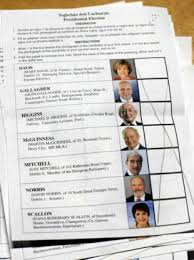 I didn’t vote for a second term for Michael D, not because I feel that he is not qualified for the job but that he is too qualified when measured by the old time political metrics. Don’t misunderstand me, at the first election he was the only one who understood the constitutional role and limitations of the Presidency. I had hoped that his promise for a one term Presidency meant that perhaps this was the final fling of the political consensus that sent an old politician to the Aras for a nice retirement, leaving the major centrist parties free to ignore an inconvenient and expensive election. But leopards don’t change their spots, especially old ones. Once Michael D had his feet under the Presidential Desk at the Aras for seven years the prospect of unemployment seemed less inviting. Had either of the two Mary’s made this about face there would have been outrage but because it was Michael D, no one was really surprised. No one was surprised about delaying his decision to run so that opponents had to scramble to seek adoption by councils that were on holiday. No surprise either that they would have no time to build a campaign or, that he was suddenly so busy that he could only debate on his terms. This was old style and typical of the smoke filled rooms that gerrymandered politics of the past.
 I would think that it is fairly rare that one day after the implementation date of a new Act that headlines such as ‘Drink Driving Laws too Weak’ would appear(The Times 27/10/18) . However, this is the Act that Minister Ross introduced to appease public pressure to do something about the mess that are the RTA’s and their policing. It was also a Bill that was heavily criticised, not for the proposed penalties but for any realistic attempt to reform the rickety structure that governs enforcement of the Road Traffic Acts in Ireland. I wrote an essay on the subject in July, using data mainly drawn from an RTE program and the basic issues that were raised were not addressed in any serious way